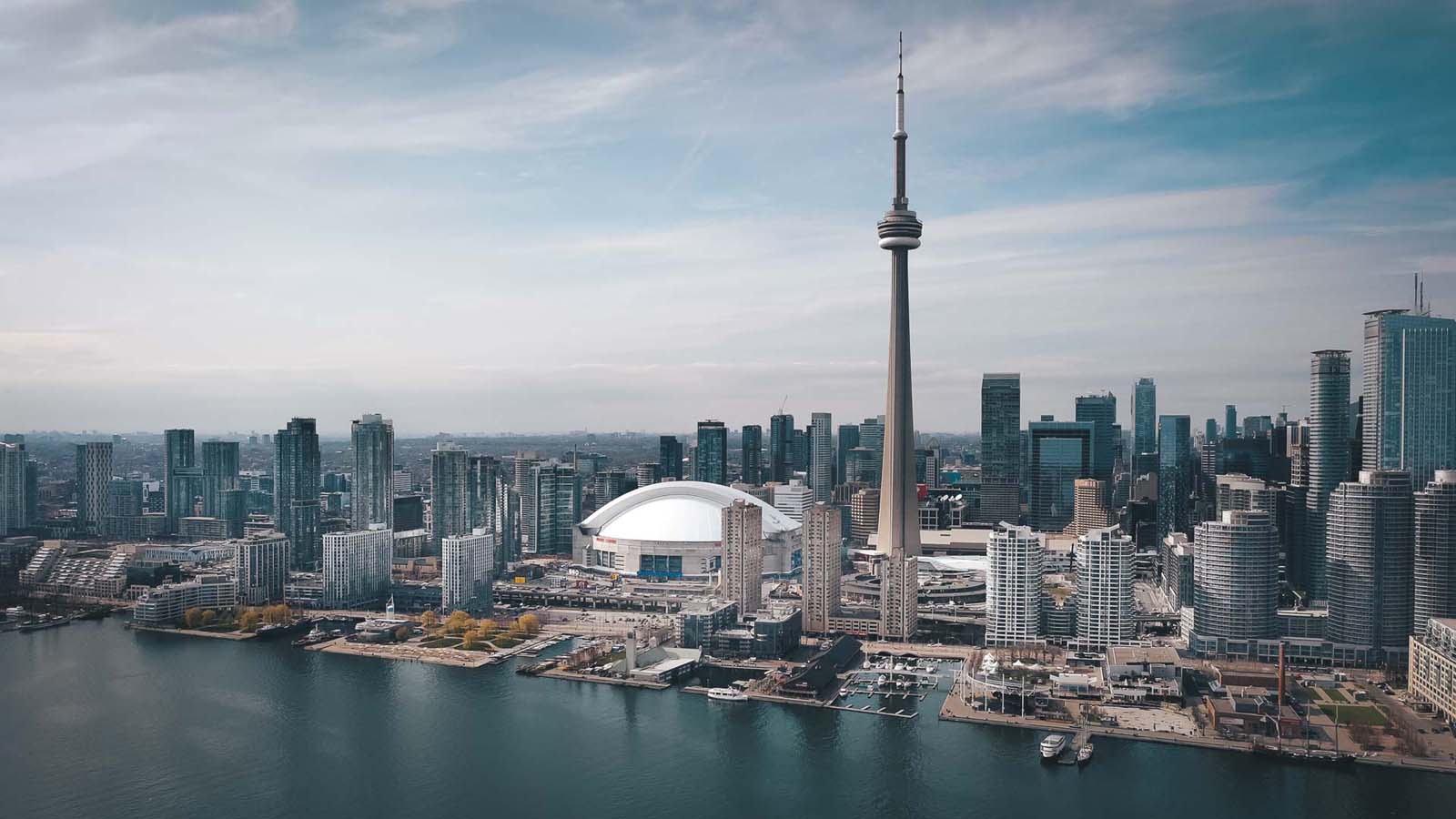
The CN Tower (French: Tour CN) is a 553.3 m-high (1,815.3 ft) communications and observation tower in Toronto, Ontario, Canada. Completed in 1976, it is located in downtown Toronto, built on the former Railway Lands. Its name "CN" referred to Canadian National, the railway company that built the tower. Following the railway's decision to divest non-core freight railway assets prior to the company's privatization in 1995, it transferred the tower to the Canada Lands Company, a federal Crown corporation responsible for the government's real estate portfolio.
The CN Tower held the record for the world's tallest free-standing structure for 32 years, from 1975 until 2007, when it was surpassed by the Burj Khalifa, and was the world's tallest tower until 2009 when it was surpassed by the Canton Tower. It is currently the tenth-tallest free-standing structure in the world and remains the tallest free-standing structure on land in the Western Hemisphere. In 1995, the CN Tower was declared one of the modern Seven Wonders of the World by the American Society of Civil Engineers. It also belongs to the World Federation of Great Towers.
It is a signature icon of Toronto's skyline and attracts more than two million international visitors annually. It houses several observation decks, a revolving restaurant at some 350 metres (1,150 ft), and an entertainment complex.
The CN Tower was built by Foundation Company of Canada with Canron of Etobicoke handling the steel and antenna fabrication work.
Construction began on February 6, 1973, with massive excavations at the tower base for the foundation. By the time the foundation was complete, 56,000 t (62,000 short tons; 55,000 long tons) of earth and shale were removed to a depth of 15 m (49.2 ft) in the centre, and a base incorporating 7,000 m3 (9,200 cu yd) of concrete with 450 t (496 short tons; 443 long tons) of rebar and 36 t (40 short tons; 35 long tons) of steel cable had been built to a thickness of 6.7 m (22 ft). This portion of the construction was fairly rapid, with only four months needed between the start and the foundation being ready for construction on top.
To create the main support pillar, workers constructed a hydraulically raised slipform at the base. This was a fairly unprecedented engineering feat on its own, consisting of a large metal platform that raised itself on jacks at about 6 m (20 ft) per day as the concrete below set. Concrete was poured Monday to Friday (not continuously) by a small team of people until February 22, 1974, at which time it had already become the tallest structure in Canada, surpassing the recently built 381-metre (1,250 ft) tall Inco Superstack in Sudbury, built using similar methods.
The tower contains 40,500 m3 (53,000 cu yd) of concrete, all of which was mixed on-site in order to ensure batch consistency. Through the pour, the vertical accuracy of the tower was maintained by comparing the slip form's location to massive plumb bobs hanging from it, observed by small telescopes from the ground. Over the height of the tower, it varies from true vertical accuracy by only 29 mm (1.1 in).
In August 1974, construction of the main level commenced. Using 45 hydraulic jacks attached to cables strung from a temporary steel crown anchored to the top of the tower, twelve giant steel and wooden bracket forms were slowly raised, ultimately taking about a week to crawl up to their final position. These forms were used to create the brackets that support the main level, as well as a base for the construction of the main level itself. The Top was built of concrete poured into a wooden frame attached to rebar at the lower level deck, and then reinforced with a large steel compression band around the outside.
While still under construction, the CN Tower officially became the world's tallest free-standing structure on March 31, 1975.
The antenna was originally to be raised by crane as well, but, during construction, the Sikorsky S-64 Skycrane helicopter became available when the United States Army sold one to civilian operators. The helicopter, named "Olga", was first used to remove the crane, and then flew the antenna up in 36 sections.
The flights of the antenna pieces were a minor tourist attraction of their own, and the schedule was printed in local newspapers. Use of the helicopter saved months of construction time, with this phase taking only three and a half weeks instead of the planned six months. The tower was topped-off on April 2, 1975, after 26 months of construction, officially capturing the height record from Moscow's Ostankino Tower, and bringing the total mass to 118,000 t (130,000 short tons; 116,000 long tons).
Two years into the construction, plans for Metro Centre were scrapped, leaving the tower isolated on the Railway Lands in what was then a largely abandoned light-industrial space. This caused serious problems for tourists to access the tower. Ned Baldwin, project architect with John Andrews, wrote at the time that "All of the logic which dictated the design of the lower accommodation has been upset," and that "Under such ludicrous circumstances Canadian National would hardly have chosen this location to build."
Video about the Contruction of the CN Tower
When the CN Tower opened in 1976, there were three public observation points: The Top (then known as the Space Deck) that stands at 447 m (1,467 ft), the Indoor Observation Level (later named Main Observation Level) at 346 m (1,135 ft), and the Outdoor Observation Terrace (at the same level as the Glass Floor) at 342 m (1,122 ft). One floor above the Indoor Observation Level was the Top of Toronto Restaurant (now named "360 The Restaurant at the CN Tower"), which completed a revolution once every 72 minutes.
The tower would garner worldwide media attention when stuntman Dar Robinson jumped off the CN Tower on two occasions in 1979 and 1980. The first was for a scene from the movie Highpoint, in which Robinson received CA$250,000 ($981,875 in 2023 dollars) for the stunt. The second was for a personal documentary. The first stunt had him use a parachute which he deployed three seconds before impact with the ground, while the second one used a wire decelerator attached to his back.
On June 26, 1986, the tenth anniversary of the tower's opening, high-rise firefighting and rescue advocate Dan Goodwin, in a sponsored publicity event, used his hands and feet to climb the outside of the tower, a feat he performed twice on the same day. Following both ascents, he used multiple rappels to descend to the ground.
From 1985 to 1992, the CN Tower basement level hosted the world's first flight simulator ride, Tour of the Universe, based on the flight of a Space Shuttle. The ride was replaced in 1992 with a similar attraction entitled "Space Race." It was later dismantled and replaced by two other rides in 1998 and 1999.